• Skip to primary navigation
  • Skip to main content
  • Skip to primary sidebar

IELTS Training with Jonathan

Helping Busy People Succeed in IELTS.

Facilitating student success in the IELTS Exam.

  • New!
  • About
  • Courses
  • Essay Questions
    • Task 1 IELTS
    • Task 2 IELTS
    • General Task 1
  • E Books PDF
    • IELTS PDF’s
  • IELTS ESSAY FEEDBACK CORRECTION
    • 10 IELTS Essay Corrections and Development Feedback
    • 2 Pre-test IELTS Essay Corrections and Feedback

IELTS Reading

Invest time in IELTS Topic Areas – Reading

By ielts-jonathan.com on 18 June 2021 0

IELTS READING TOPIC AREAS READING MAGAZINES NEWSPAPERS

IELTS Topic Articles that feature in the IELTS test for Vocabulary and Topic Awareness

Without topic awareness, you can’t fully answer the question Without vocabulary, the question can’t be fully answered

I’ve prepared a selection of good articles to read according to their topic area. I am adding to this list as I find IELTS worthy reading articles. 

Daily chart - The stark relationship between income inequality and crime | Graphic detail | The Economist
Both theory and data suggest that if you’ve got it, don’t flaunt it

This is one of the many articles I’ve found which, from experience, I know feature heavily in the Reading and Writing IELTS test. You won’t find questions in the IELTS test directly related to these articles, but but if you want to give yourself a better chance, read around them to improve your exam performance response and vocabulary.

Why should I invest time in reading for IELTS
Reading topics Reading IELTS Invest time reading

Having an awareness of IELTS topic areas indicates in your writing and speaking that your opinions are relevant.

Just by being prepared means that you are better positioned to give an opinion on any number of popular topic areas. 

This is especially the case in writing. The ability to generate ideas under the pressure of the exam is usually down to a lack of knowledge around the key topic areas, while having topic awareness in IELTS speaking will just make the exam seem so much easier.

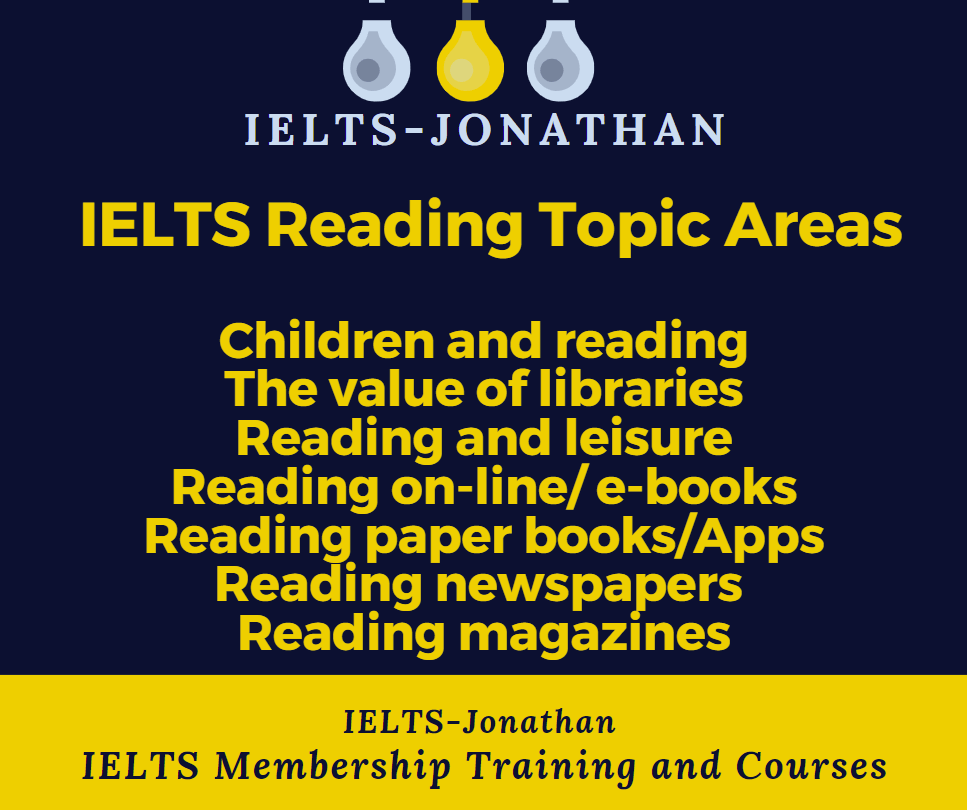
Common IELTS Topics
IELTS COMMON TOPIC READING AREAS

Searching for IELTS worthy reading and listening articles is not easy.

It’s important to read articles that follow basic academic patterns and use vocabulary and grammar which is useful for IELTS improvements.

The articles I have linked to feature the most common general topic areas I have seen in IELTS reading, writing and listening.

Using some of these resources is not only good for increasing vocabulary levels, reading comprehension and speed, but will help provide a foundation of ideas important for topic awareness and idea generation. 

If you want a list of the main topic areas and the subheadings, you can find out more here but below are new the new links I am creating for ‘Reading’.  I recommend you identify areas you’re not familiar with and flick through some of the topics postings below.

Choose a few to read or listen to and if your vocabulary is a weak spot, note down words and phrases you can reuse in the future. 

Vocabulary and topic awareness are just as important as exam techniques!

Reading as an IELTS topic

Climate change is not a key cause of conflict, finds new study
We looked at ten countries in East Africa and found poverty and politics were much more important drivers of conflict and displacement than climate change.

Why email loses out to popular apps in China
Email has never been huge in China, and it’s down to a combination of cultural factors and timing.
How keeping a diary can help adults learn a foreign language
A post-lesson diary is a promising teaching tool which helps students reflect on language connections and replay their learning steps.
Knowledge of medicinal plants at risk as languages die out
Loss of linguistic diversity means less chance to discover age-old remedies not known to science, study warns

Other IELTS reading Sections

EDUCATION IELTS ARTICLES
IELTS Topic Areas - Education
IELTS Reading Topics and Articles that feature in the IELTS test. ″Without topic awareness, you can’t fully answer the question
ENVIRONMENT IELTS ARTICLES
IELTS Topic Areas - The Environment
IELTS Reading – Topic Articles that feature in the IELTS test.  I am adding to this list all the time so students can acquire vocabulary […]

Share
Pin3
Share
Tweet
3 Shares

Share this:

  • Click to share on Twitter (Opens in new window)
  • Click to share on Facebook (Opens in new window)
  • Click to share on Pinterest (Opens in new window)
  • Click to share on WhatsApp (Opens in new window)
  • Click to share on Telegram (Opens in new window)
  • Click to share on Tumblr (Opens in new window)
  • Click to share on LinkedIn (Opens in new window)
  • Click to print (Opens in new window)

Like this:

Like Loading...

IELTS Reading – How to make Reading quicker and easier

By ielts-jonathan.com on 3 May 2021 0

IELTS READING QUESTIONS HOW TO

What does IELTS reading test?

Many people think that IELTS reading is about displaying the ability to read and understand written English.

However, the way the test is written means it is designed to show much more than this.

In addition to the knowledge and amount of words you know, or to put it another, better way, new words you can comfortably deal with, IELTS reading tests your current language level and organisational operating skills in English.

This can be used as suitable predictor for university study and, in the case of the IELTS General Test, for workplace situations.

The format and material used are designed to be fair and reflect your current language level.

The materials are extensively pre-tested before being used and this is why you should only practice using official, published materials.

Quite often I see tests that claim to be suitable for IELTS, but they don’t reflect the real test.

Online materials and self-designed courses can be regarded as useful vocabulary building exercises, but too often they test unrealistic or simplistic items of language and text and so cannot be regarded as valid.

Why is IELTS Reading difficult?

Future demands

Studying at university is demanding and the reading and writing is extensive.

Working in a profession abroad in English is demanding and often there is a great deal of responsibility so the test needs to predict to a certain degree whether you are up to the job of studying or working in English speaking environments.

Your present language levels

If your current language level is not up to the level required for your studies or work, then the IELTS test will remain a challenge, I can’t be more honest than that.

Other factors which make the test difficult

Good language skills and abilities ae often not enough. Many test-takers struggle with the format and the timing. In fact, timing is one of the biggest issues I see.

You only have 60 mins to read three extensive reading passages, answer 40 questions and transfer the answers to a separate sheet.

Low language level users will always find this more challenging than near- native or native speakers.

What is the Reading test designed for?

The IELTS tests a number of sub-skills

Although IELTS is primarily a language level test, reading also considers the specific skills needed for study and the workplace.

These are related to locating general ideas and specific information, summarising and paraphrasing and comprehending facts and opinions as well as general organisational understanding of extended reading.

What are the main student problems?

The students who often have the most problems are the ones that

  • don’t yet have a sufficient level of vocabulary, (they may get stuck understanding words or may misunderstand the meaning) 
  • don’t have sufficient knowledge of the reading test (they may get confused or misunderstand the text)

If you are weak in these two areas, then it is very difficult to apply a reading strategy for the different types of questions

Without these strategies, you can spend too long reading details or trying to locate sections for the correct information

‘So if a student does not have the experience, or a good level of vocabulary or understanding off how to approach different sections of the text , they will find the reading test challenging.’

General IELTS reading improvements

IELTS READING QUESTIONS HOW TO

  • Tip – It is important to work on building up your vocabulary. You can do this by general reading and reading more specific articles that may relate to topics in the IELTS exam but don’t include learning specific vocabulary that you get from practice tests.
  • Tip – Practise the test – to understand how the different questions work but don’t rely on doing test after test after test. If you’re doing something wrong, then you will do it wrong again in the next test too.
  • Tip – Don’t rely on online materials for practical IELTS experience, they are not valid or reliable and you will often be learning to do doing something that does not feature in the test or your academic studies. They are, however, useful for vocabulary building and text organisation.
  • Tip – Once you understand some of the test features, practice strategies to improve your reading comprehension and reading speed. For example, take a passage (and this could be one of the free online practice tests) and try to understand the gist, the text location of key people, dates or facts, main figures and ideas as well as an overall understanding. 

Good News

The IELTS test is not there to trick you, it is designed to test your ability to deal with the organisation of a complex text and your level of comprehension.

You don’t need to understand a text completely but the test will indicate how you can deal overall with paraphrasing, synonyms and referencing.

There are strategies you can follow like skim and scan reading for organisation and location and there are features of the test which are predictable.

That’s what we are going to summarise next.

IELTS Reading question types and formats

There are 14 different question types with their own individual format.

Many of them have similarities in the test strategies you can use to achieve the task, and some have similar functions in terms of what they are testing.

Types Reading IELTS Question

I recommend that you study the questions in the categories I’ve organised and then practice each type of question a number of times.

You can use the official IELTS resources, or if you have access to a library at school, you can use the Cambridge Guide to IELTS series which is a reliable and valid collection of materials.

Locate the questions in the index of the book and practice the same questions together.

Remember that there are three sections, each with a reading passage. In the test always make sure your handwriting is clear.

Errors or illegible writing are marked as wrong!

Questions which follow the order of the Reading Passage

The first set of questions to look at are questions that appear in the order of the reading passage. 

Multiple Choice.

This type of question often tests your understanding of factual information in the topic rather than views or opinions.

As you can see in the example, there are five options to choose from and two answers to complete. This means that only two of the five are correct and three are wrong, incorrect or not a direct match according to the passage.

The task requires you to locate areas of the text and then examine the vocabulary carefully.

It’s helpful that the correct statements follow the order of the passage, but you will need to examine the wording carefully. It won’t be repeated in the text but the wording could be very similar.

A good way of approaching the task is to read each statement and begin skimming to locate information from the beginning. Once you have found what you think might be useful, mark it and continue reading for the next statement.

When you are reasonably certain you have identified the two statements, examine the text in more detail.

If you are not sure about a statement, try to find reasons or examples why that statement is NOT correct.

Never use your own experience or knowledge of a topic. Only examine the text with purpose of the test.

Rather than writing out the statement, you should only write the letter of the statement for 1 and 2.

If you are unable to find an answer, write something….never leave a blank space!

Sentence endings

These questions focus on understanding the views and opinions of the writer although facts and figures will be present.

You will need to correctly identify the views of the writer and also compare and contrast information which supports a view or an argument.

The question presents you with a reading passage and numbered sentence starts. These are followed by the sentence endings which are lettered.

At the end is space where you can write the letter which matches the number.

The numbers follow the order of the passage and may not contain some words from the passage. You can use these words to help identify sections which refer to the ideas in the passage.

It’s important to understand the views fully before making assumptions and matching the endings. Small words in the text may greatly change the overall meaning.

Don’t try and use grammatical knowledge to match the endings and don’t use your own experience either.

Don’t do this because

There are more options than questions and all of the sentences will grammatically fit together. Your own experience may be different to the views in the passage.

You are only focussing on matching the views and claims in the passage.

First quickly read the first half of the sentences (that’s 1, 2, 3, 4 and 5).

This will give you a very helpful idea of topic development and gist in the text

In this kind of question key words are important so underline these, as well as any names, dates or main ideas.

The questions follow the order of the passage so start reading and systematically note sections of the text which are important because of the keywords.

Don’t underline the keywords, it will make the passage messy and distracting to read.

Write a number in the margin to indicate which section you think this part of the passage refers to.

Once you have done this, go back to each section and compare the ideas with the sentence starts to confirm you are working in the right area.

Finally, move to the sentence endings and start matching these. At the same time, you can check the information agrees with the claims and views in the passage.

Although you are matching the sentence endings you should only write the letter in the answer box. Make sure it is clearly written!

Finally, remember that the sentences will appear in the text in the order of the questions so you could check your decisions again but only if you need to.

You can systematically work your way through the questions and the passage together.

Short answer

Examples of short answer questions focus on answering factual information using vocabulary taken from the reading passage.

The questions check your understanding of the subject matter and you need to write words or numbers and be specific in the amount of words you use.

Skim is an important skill in this question. You may find that similar information is repeated but you can work through the text following the questions in order.

It is important to only write the number of words specified, too many, or too few, is a wrong answer.

Most of the words you will be looking for will be nouns.

You will see that some of the words in the question may also appear in the passage.

It is important that you copy the words only as you see them in the passage paying attention to whether they are singular or plural or countable.

Don’t use your own words to complete the answer and don’t change the word form either!

Of course, spelling is important. Words that are difficult to read or spelt incorrectly are marked as wrong.

In this task, reading the questions first is important.

Remember you are mostly checking facts so as you read the questions, consider the type of information you need to find, for example, a date, a time, a place, a number, a name, a location.

  • Read questions first and note the information you are looking for
  • Read the passage and questions in order
  • Locate the likely information and double check
  • Write the answer exactly as you see it
  • Check you have not written too many or too few words.

Sentence completion

In this task, the questions test your ability to locate and record factual subject specific information. These can be words or numbers.

The statements will not have the same words as in the passage, but the information will be the same.

The instructions tell you how many words you should write , for example, ‘Choose NO MORE THAN ONE WORD AND/OR A NUMBER’.

You should write the words as you see them. Don’t change the word form.

Read the questions first and note the type of information you are locating.

For example, grammatically the gaps below could be filled by one noun and one verb.

Chomsky’s’ findings are regarded as important in the field of ……. (linguistics)

The publisher was nearly …….  due to the poor response to the publication. (bankrupted)

Note how the words in the question could produce a number of synonyms in the passage.

For example, the ‘field of’ could produce an area of, study of or in the  discipline of in the passage.

Gaps, however, could be as easily filled by compound nouns of more than one word.

‘Choose NO MORE THAN TWO WORDS AND/OR A NUMBER’.

Participants were reminded that …………. was at a certain time.

The results of Preston’s study indicated that the growth of plants accelerated at the time of a …………..

It would seem that just by increasing the number of ………….. did not correlate with the increased number of weekend passengers.

Check out full moon bus stop

Don’t write numbers as individual words, write them as the number, like this – 256.

The first step is to read the questions quickly.

When you move onto the passage you will probably notice there are a number of words that could grammatically fit each question statement, area of, study of.

There may be a number of distractors in the passage so it’s important that you check carefully the words you have chosen exactly report the passage.

Go through the passage as you go through the questions, remember the questions are in the order of the passage.

Don’t just write down the first word that grammatically fits, think carefully about the meaning and the number of words that fit.

If you do struggle with an answer, always write something in the space for answers and never leave a blank!

After all, your guess could be correct!

True, False Not Given 

These questions ask you to effectively locate information in the reading passage and answer the statement after reading the details carefully.

Some people confuse True, False, Not given questions with Yes, No, Not given but the distinction is quite clear.

These questions are related to factual information. This means it will be mostly figures and facts.

True means that the statement agrees with the passage information

False mean that the statement is the opposite or contradicts the passage information

Not given is, as it says, there is no information related to the statement

You can locate the next information as you answer the next statement, they run in the same order!

You will need to skim read to locate the relevant areas of text.

When you locate the correct area of the passage, be aware that if the information is True, the wording will be paraphrased. Read that carefully!

This section means you need to scan the text for synonyms and paraphrases around these facts.

Sometimes the exact words are used in the statement and the passage.

You will need to compare the language and decide if the statement is the same (T), whether it is F ( the opposite) or if there is not enough information to form an opinion, meaning it will be NG.

Yes, No, Not Given

Similar to T, F not given, you need to effectively locate information in the reading passage and answer the statement after reading the details carefully.

However, these questions are related to views, opinions, and claims rather than factual information. You need to consider and compare arguments or how ideas are presented.

Yes The views of the writer agree with the statement.

No The views of the writer are different, opposite or contradict the statement.

Not given is, as it says, there is no clear information or not enough to be sure about the views or opinions of the writer.

You can locate the next information as you answer the next statement, they run in the same order!

You will need to skim read to find the locations of relevant ideas.

When you locate the correct area of the passage, be aware that if the opinions and views are yes, then the wording will probably be paraphrased and need careful reading.

This section means you need to scan the text for synonyms and paraphrases around authors views.

Sometimes the views use the same words as in the statement and sometimes they don’t!

Scan and consider the use of synonyms and paraphrasing.

Carefully compare the language and decide if the statement is the same (Y), whether it is N( the opposite) or if there is not enough information to form an opinion, meaning it will be NG.

Always remember it’s not enough just to locate the areas of information. You are not being tested on this skill, but on your overall comprehension!

Questions which do not follow the order of the Reading Passage

The second set of questions are questions that do not appear in the order of the reading passage. 

This means you cannot systematically read the questions and the passage together.

Matching Headings

These questions may seem like a simple matching exercise, but are more complicated than that. 

It’s important to understand what this kind of question is testing and some of the common issues students face if unprepared.

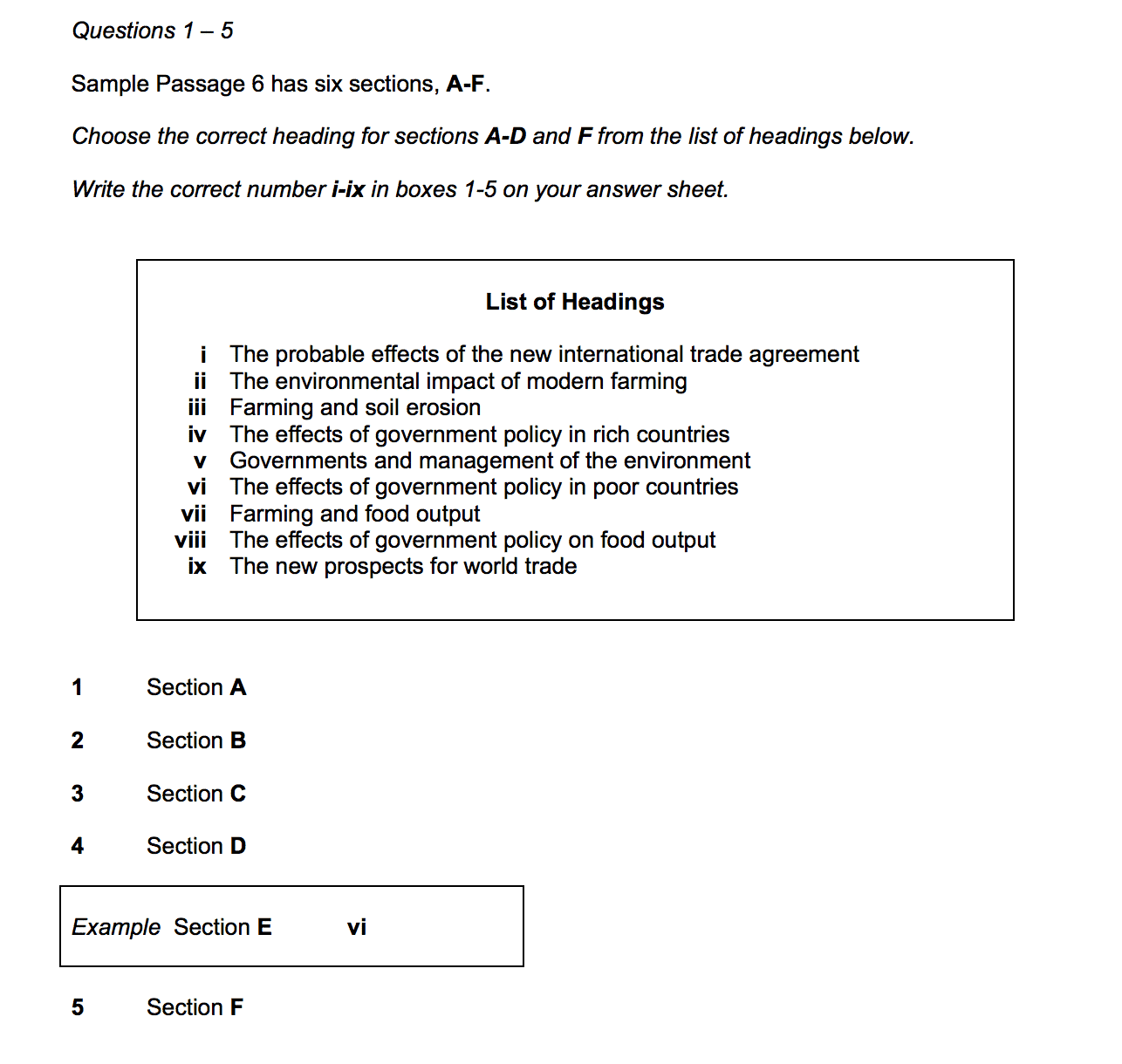
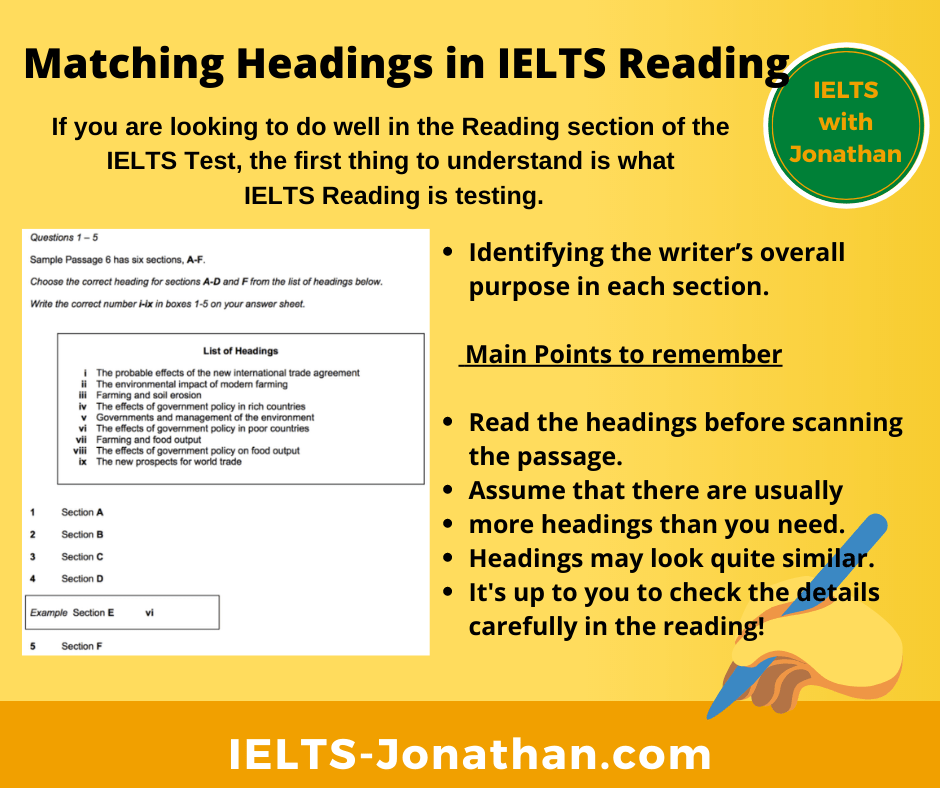
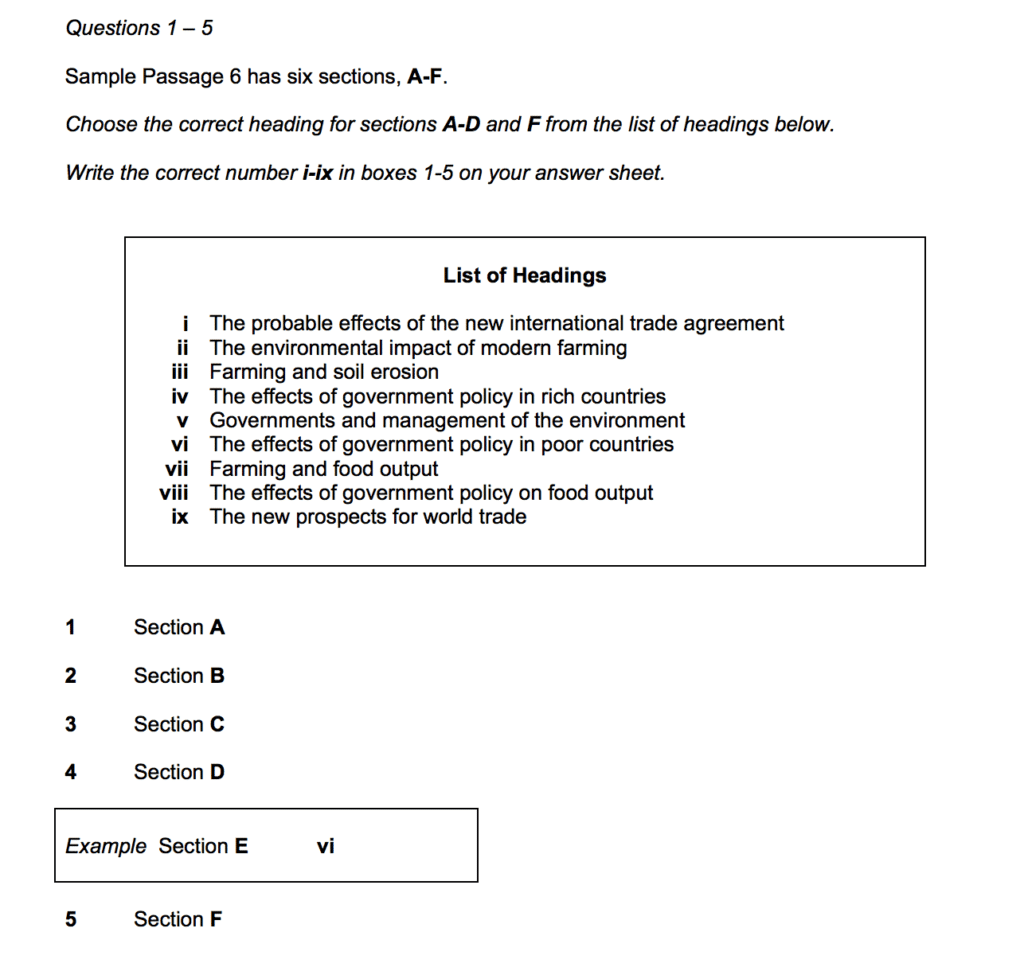
This is an example of a Matching Headings question.   

In the first box of this question, you can see the headings you can choose from. These are numbered in Roman numerals (i -vi)

Below that , is the area where you match your heading choice with the section A, B, C etc.

These are numbered in order.

What may look like a simple task, hides many subskills which you need to utilize for a good score in this area.

To understand this, I have summarised the question type by describing these skills and provided useful tips to help you deal with this section.

The Task:

As you can see, the basic task is matching the most appropriate heading (signified by numerals) to the appropriate section in the reading passage, signified by a letter. 

It should be clear that how you organise your answers is important and care needs to be taken when transferring the answers, as just one mistake could ruin this section.

As well as organisational skills, the section also tests your cognitive skills.

You have to deal with multiple information such as numerals, numbers, letters, select headings and evaluate extensive text under test conditions.

What skills are needed for matching headings?

The first practical skill is to be able to skim and then scan read.

Remember that the questions do not follow the order of the passage.

You need to locate similar information, compare and select the most suitable match.

Be prepared for synonyms and also referencing words that refer forwards and backwards in the text.

For each of the five sections of the extensive reading (A – D) gaining the overall gist of the section by skimming reading will help you identify the probable headings that match the section.

Once you have an educated idea of the likely matches, then scanning takes place for specific information so you can confirm the heading is correct or not.

If you need to brush up on what these skills are, I’ve prepared a skimming and scanning post with practical explanations of these important IELTS skills. 

Reading the headings quickly before reading the passage always helps. This will help you recognise the key words and synonyms from the headings. once you think you have found the correct section you can scan the keywords in the text.

Be careful, just because you see a keyword does not mean that it is the topic of the paragraph. You still need to read carefully around the text to confirm. 

You should be clear there are usually more headings than you need and some of these headings might look similar so again, look carefully for distractors

In the example question, headings i and heading vi are quite similar and viii is related too.

You will need to check the details carefully in the reading text to confirm your decisions. 

There are likely to be many new words that you are not familiar with.

Don’t be distracted by these new words.

Use the context to try and understand the general meaning, but don’t over focus on the meaning too much.

Most of the surrounding information will help you move through the text.

Complete Guide here

Matching features

The task confuses students because there are two different types of question which look very similar to each other but come under the same question classification.

It can be tricky to understand at first but with practice you will create a good habit and you can focus on the task itself.

The question tests whether you can understand the main ideas, in addition to understanding more detailed information and arguments in the passage.

Although you may see differences in the tasks format, they are really testing the same reading skills and in the same way.

When you come to practice these questions, one way to spot the difference is that the first question features numbered statements.

Question type 1

In this question set there will be a number of statements. It is important to remember that these statements do not come in the order of the passage, although they are numbered, they are arranged randomly.

The statements will not use words and phrases from the passage, but of course they will refer to information and ideas in the text.

The answers, which go with the statements, are lettered, so you answer the question by placing the appropriate letter against the numbered statement.

So A) London B) Paris and C) Madrid, are matched to statements 1, 2 ,3 etc.

All the letters need to be used and letters can be used more than once

The second question type is recognisable by numbered sets of features.

Question type 2

In this question set, instead of statements, there will be a number of features.

It tests whether you can locate the main theories discussed in the text.

The answers appear as the statements are ordered in the text. 

As an example, these could a be a list of names, companies or organisations connected to the text.

There will also be a box that contains the options to work with.

In this example, the task would be to match the name to the theory or contribution to science

For example, the feature could be an airline manufacturer and its contribution to aero science like this for example.

Boeing, Vickers, Bell, Airbus, match to 1, 2, 3 which is a contribution to airline development mentioned in the reading.

Remember, these features are ordered as they appear in the passage, they are not random.

As before, the answers, which go with the statements, are lettered. To answer, place the appropriate letter against the numbered statement.

All the letters need to be used but in this question the letters cannot be used more than once.

How to answer both types of question

In both questions you should read the statements and features first of all. This will give you some gist of what you are going to read about.

Then begin reading the passage but as you do so, note with an underline phrases where you see information directly related to a feature in the text or mark sections where you see information related to statements.

You are likely to mark more than one phrase or section, so the second stage is to begin looking more carefully to see if the ideas match more precisely. Remember the second type of question has two parts that need to match together.

Always write an answer and don’t leave a blank.

Matching information

In this task, individual paragraphs are numbered. It might look like the principle is to match  statements ( 1 – 7 for example) with the main ideas of the paragraph. The statements are likely to deal with more detailed information and arguments than just the main idea.

Although the paragraphs (and the letters) are in order, the statements (and numbers) are not, they are randomly ordered.

 As with other tasks, although the wording refers to ideas in the passage, the wording is not the same.

A good point about the statements is that they indicate the type of information you need to search for. Examples in past papers have been an example, a reference, the realisation, the idea, so it’s important to check these first and then note what kind of example or reference you are looking for.

You write the letters next to the numbered statement.

So, first of all, read the statements and note the kind of information you will be looking for, whether it is an example, an idea or prediction. 

Read the text quickly and mark the passage where you feel the information you are looking for can be found. Note that there may be more than one example of the kind of information that you need to find; there may be more than one prediction or reference in the same paragraph.

Also be aware that lettered paragraphs may contain information on more than one statement so you may read the same section twice for a different reason or you may not read a paragraph at all.

If you have any statements left unanswered, write a letter anyway.

Don’t lose points for a no  answer so don’t leave a section blank.

Summary completion

The main testing principle is dealing with two extensive sections of text on the same topic, locating factual information and checking details against both texts.

The longer text is the original material and the shorter one is a summary of the main points, much like summary notes you might write at university.

While the summary reports the main ideas from the longer text, the information may not be in the same order as the original so you cannot systematically read both texts together.

You will need to check the instructions as you may need to write more than one word, like this ‘Choose NO MORE THAN TWO WORDS AND/OR A NUMBER’

To complete this task read the summary first noting the main ideas and key words. This will help indicate the type of information that is missing, for example, numbers, a name or something specific. 

You may see that part of the summary refers to the meaning of the passage rather than specifics within the passage.

Then begin reading the longer text, noting the main words, ideas and key words from that text.

Return to the summary, focus on each gap in the text, and return to read the main passage sections you think deals with this.

There will often be clues in the summary that indicate the type of information you are looking for.

For example, the phrase

‘as far back as’

indicates you are looking for a time period, more specifically a date, these phrases,

‘figures indicate a sharp decline in ………’    ‘this increased by around…….’

indicate you are looking for (1) a noun or noun phrase and (2) a number.

It may not be as easy as this in the reading and there may be, for example, many numbers so you do need to read around the main passage to check.

Hopefully as you read, you will begin to see the words you need to write.

Copy the word exactly as you don’t need to change them in any way. They will grammatically fit but remember the number of words you need to write and check your spelling is the same.

Don’t use the spelling you are used to, use the spelling from the text.

A word could be a number so write it exactly as you see it, like this, 257, as a number.

Finally, you will need to transfer the ‘words or numbers’ to the answer sheet so the spelling on the answer sheet needs to be checked again.

Question Set 3 Notes, Tables Diagrams and Flowcharts.

The final set of questions may or may not come in the order of the passage.

As the content and strategies to follow are broadly similar, they have been grouped together.

Any differences are highlighted in the following text.

All of these tasks ask you to locate specific information from reading passages and record it accurately. These tasks test your understanding of factual information on a specific subject topic. So the text will have many facts about the subject.

You will find information related to the passage in the form of a table, notes of a diagram etc, and using information from the passage you need to complete gaps in the text.

As with other tasks, you need to write words or numbers to complete these gaps.

We can regard all of these tasks as a note taking task:

Notes can take the form of:

A set of notes in a table

A set of notes under headings

A pictorial diagram or flowchart with associated labels for making notes

Always prepare yourself by looking at the notes before you begin to look at the passage.

For information in a table, read the information from left to right and not top down and you usually follow the order of the passage.

Labels on diagrams go in clockwise order around the diagram and a bonus is the question numbers follow the order of the passage. 

A flowchart is as it describes, so you should follow it from start to finish.

When you look at the notes, think about the kind of information you will need to complete it and check the number of words.

The majority of the missing words are about facts so will likely be nouns or compound nouns, but not always.

When you move to the passage, you will find that a number of words could grammatically fit so you need to double-check the words you choose are the correct choices and report the intended meaning.

When you have decided on the correct words, write them in the gaps.

Don’t change them in any way, they are to be used as they are seen and make sure your writing is legible.

Spelling errors and words that can’t be read clearly are marked as wrong.

Remember that …

Dealing with a large text and 14 types of question format can be a real challenge.

A good way to make the task less daunting is to become an expert in understanding the kind of skills each task is designed to test.

A question that may appear to be a simple task will have a test principle behind it and so it may not be a simple as it appears. 

Solution

If you understand the testing principle, it will help you complete the activity easier and the task easier.

You will also understand and avoid the problems that the majority of test-taker’s experience. 🙂 


Types Reading IELTS Question


IELTS READING MATCH HEADINGS JONATHAN


You can use tips and information on this website to help make it easier to obtain a higher score, but remember you still need to work at learning the language to be successful.

IELTS FREE CHALLENGE

Please share to someone you know and in the meantime take a look at my Facebook Page and Website for IELTS answers and you can also join my Facebook Group here too.

Good Luck 

Jonathan

The Best Approach to Task 2 Writing

Paragraphing in Task 2 Writing

Strong Arguments for Task 2

Writing the Introduction

Writing a Line of Argument

Cohesion for Task 2 Writing

Writing – Benefits of a Foreign University Education


I’m Jonathan

I’ve taught IELTS and University English in more than a dozen universities and schools around the world.

I’m a parent, traveller and passionate about language teaching and helping students achieve their dreams.

Whilst living in Austria or working in Asia, I run IELTS courses to help students get to where they want to be.

If you are serious about IELTS, connect with me to see how I can help you.

Sign up to the Newsletter

Like this:

Like Loading...

How to answer Matching Headings questions in IELTS reading.

By ielts-jonathan.com on 3 April 2021 1

How match Headings IELTS Reading Task

How to do matching headings tasks 

I always suggest being careful with this type of question.

These questions may seem like a simple matching exercise, but there is more to it than at first appears.

It’s important to understand what this kind of question is testing and some of the common problems that students have if they are not prepared.

So, let’s briefly begin to understand the task and it’s purpose.

Just to summarise, the reading section lasts for one hour and the exam format for the Reading section is 3 reading passages and 40 questions.

Each reading passage has 3 or 4 different types of question to answer so this question can come almost anywhere. 🙂 

Matching Headings IELTS

Matching Headings in IELTS Reading

This is an example of a Matching Headings question.   

In the first box of this question, you can see the headings you can choose from. These are numbered in Roman numerals (i -vi).

Below that , is the area where you match your heading choice with the section A, B, C etc.

These are numbered in order.

IELTS READING MATCHING HEADINGS

What may look like a simple task, hides many subskills which you need to utilize for a good score in this area.

To understand this, I have summarised the question type by describing these skills and thought of some useful tips to help you deal with this section.

The Task:

As you can see, the basic task is matching the most appropriate heading (signified by numerals) to the appropriate section in the reading passage, signified by a letter. 

It should be clear that how you organise your answers is important and care needs to be taken transferring the answers, as just one mistake could ruin this section.

As well as the se organisation skills, the section also tests your cognitive skills.

You have to deal with multiple information such as numerals, numbers, letters, select headings and evaluate extensive text under test conditions.

What skills are needed for matching headings? 

The first practical skill is to be able to skim and scan read.

For each of the five sections of the extensive reading (A – D) gaining the overall gist of the section by skimming reading will help you identify the probably headings that match the section.

Once you have an educated idea of the likely matches, then scanning takes place for specific information that confirms the heading is correct or not.

If you need to brush up on what these skills are, there’s a skimming and scanning post with practical explanations of these important IELTS skills here. 

What are sections for?

Let’s be clear now and understand what a section means, and the differences to a paragraph.

First of all, the aim of a section is very different to a paragraph.

Sections may deal with overall themes.
For example, they may have a particular purpose in the reading.

The purpose might be to introduce the discussion, present the issue, consider the problems, suggest the solutions, summarise the information discussed and conclude. 

So you need to be able to skim read quickly to gain an idea of the theme of a section.

Understanding what paragraphs are for

While sections may have a number of general points, controlled by a heading, the aim of a well-written paragraph is to present one main idea.

Paragraphs do not usually have headings to indicate the content, but you can find the main idea of a paragraph in the topic sentence.

In simple writing, the topic sentence is often found at the beginning of the paragraph, but you may have to read further to identify the topic in the more complex writing found in IELTS.

This is a simple example of a topic sentence.

‘For many years, the meat industry has had a significant impact on the farming methods of developing countries. This influence on farming methods can be seen in……..etc’

You can see how the topic is introduced clearly. For many years, the meat industry has had a significant impact on the farming methods of developing countries.

Another way of identify a topic sentence is to look for contrasting linking words.

‘However, as countries become more developed it is clear that farming methods change in response to the needs of both consumers and exports.’

In the example, the contrasting statement ‘however‘ signifies that the new topic is being introduced. 

If we combined these two sentences, then the topic is controlled by the contrasting linking words. 

‘For many years, the meat industry has had a significant impact on the farming methods of developing countries, however, as countries become more developed it is clear that farming methods change in response to the needs of both consumers and exports.’

Generally, the topic will not be more that half way through a paragraph, so scan the first 35% of a paragraph for the topic.

How to combine the meaning of sections and paragraphs

So remember, paragraphs have one idea and although sections may have a number of general ideas, it is the headings which dictate the theme 

To identify the theme you need to scan for the main ideas and supporting points.

As your scanning, it is easy to be confused by information inserted in the text or overlook some important details.

These are known as ‘distractors‘.

If you are not aware of distractors, then you are likely to jump to the wrong conclusion and make the wrong choice.

A good example of a distractor is locating a section in the reading text by skim reading for keywords or synonyms and then discovering the main topic is different.

For example, the passage may discuss the ‘effect of government policy’ on developed countries and developing countries‘, but the main focus of the section is on ‘food production‘.

Here ‘developed‘, ‘developing’ and ‘production‘ have replaced the keywords in the headings, ‘rich‘, ‘poor‘ and ‘output.’

So always skim for the general theme, check the headings, then scan to check the headings match the keyword topic details and the final that these tally with the headings. 

What hints and tips can help you?

Reading the headings quickly before reading the passage always helps. This will help you recognise the key words and synonyms from the headings. once you think you have found the correct section you can scan the keywords in the text.

Be careful, just because you see a keyword does not mean that is the topic of the paragraph. You still need to read carefully around the text to confirm. 

You should be clear there are usually more headings than you need and some of these headings might look similar so again, be careful for distractors

In the example question, headings i and heading vi are quite similar and viii is related too.

You will need to check the details carefully in the reading text to confirm your decisions. 

There are likely to be many new words that you are not familiar with.

Don’t be distracted by these new words.

Use the context to try and understand the general meaning, but don’t focus on the meaning too much.

Most of the surrounding information will help you move on

How match Headings IELTS Reading Task

Conclusion

While IELTS reading is primarily testing you language knowledge and abilities, it is also tests a number of subskills such as being able to deal with a complex text at university or in the workplace.

You do need to have a good basic level of vocabulary, but there will be many words and phrases you will have to work around or interpret from the context.

Importantly, as with any IELTS Reading question, always make sure you have practised and understood the main point of the task as this will help you significantly.

Feel free to share and comment with any questions, or if I’ve forgotten something.

Good Luck with you IELTS Preparation

Jonathan

Share
Pin2
Share
Tweet
2 Shares

I’m Jonathan

I’ve taught IELTS and University English in more than a dozen universities and schools around the world.

I’m a parent, traveller and passionate about language teaching and helping students achieve their dreams.

Whilst living in Austria or working in Asia, I run IELTS courses to help students get to where they want to be.

If you are serious about IELTS, connect with me to see how I can help you.

Sign up to the Newsletter

What you need to know to be successful in IELTS Reading

By ielts-jonathan.com on 3 January 2021 0

IELTS READING TASK REQUIREMENTS

Task requirements for the IELTS READING

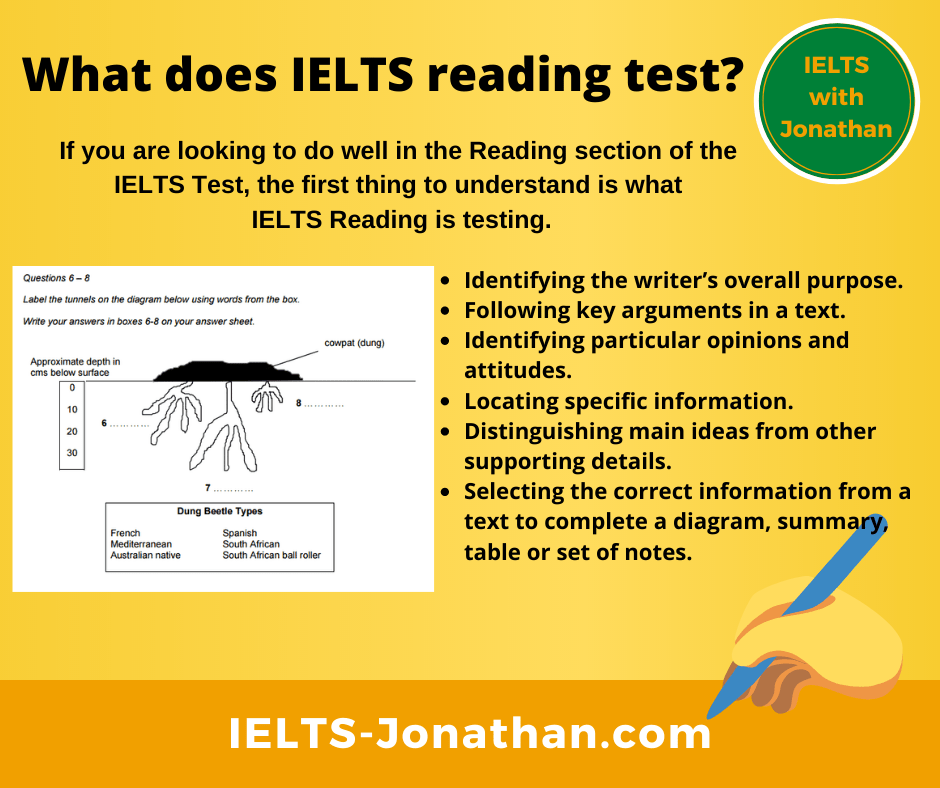
If you are looking to do well in the Reading section of the IELTS Test, the first thing to understand is what IELTS Reading is testing.

Written by specialist materials writers, these heavily tested questions formats serve a different testing function.

Some websites claim these functions are secret tips and tricks, but they’re not really.

Put simply, once you understand the function of a section this, you can attempt the task more confidently knowing what you need to do. 

Types Reading IELTS Question

IELTS Reading – Question Types

In each reading section, you will find several different tasks.

These include:

  • Answering multiple choice questions
  • Writing short answers to questions
  • Completing sentences, notes, a summaries,  flow charts or a tables
  • Labelling diagrams
  • Classifying ideas into different categories
  • Matching tasks, for example, headings to paragraphs or people to ideas.
  • Deciding if ideas or opinions are correct, incorrect or not given

The questions test your general level of language and your ability to do the following:

  • Identifying the writer’s overall purpose.
  • Following key arguments in a text.
  • Identifying particular opinions and attitudes.
  • Locating specific information.
  • Distinguishing main ideas from other supporting details.
  • Selecting the correct information from a text to complete a diagram, summary, table or set of notes.

What is the difference between Academic Reading and General Reading?

There is clearly a difference in the purpose of each test format.

General IELTS reading considers your working knowledge of English.

This means it presents the kind of language you would meet in everyday situations, and tests you ability to converse and understand in these situations.

IELTS Academic reading considers your ability to comprehend less familiar language, the kind of language you would find in university lectures, journals and papers.

It also assess your ability to work with and present these more complex ideas clearly. 

Is there a difference in scoring?

Not only is there is a difference in the language of the exams, the scoring is formatted differently as well.

The equivalent score in IELTS General reading works out to be 0.5 of a band score higher than the IELTS Academic score.

If you have a score of 37-38 out of 40, you would get a band 8.5 in the General test.

If you have a score of 37-38 out of 40, you would receive band 8.0  in the Academic test.

Academic Reading Format ✍️

The IELTS Reading module has three reading passages taken from books, magazines, journals or newspapers.

The passages cover academic topics from scientific to historical interests.

The first two reading passages have 13 questions each, and the last one has 14 questions.

Although the topic material is specialised, the material is written for a general, non-specialist audience, so you don’t need to have specialised knowledge of the topics areas. 

Specialised vocabulary needed for the task is often explained in the text or in a key

The text includes titles and sometimes captions, photos and illustrations, which help you to grasp the general meaning of the text.

If a text contains technical terms, a simple glossary is provided.

The total word length of all the texts can vary between 2,000 and 7,500 words.

At least one passage, usually Section 3, contains an argument and/or a viewpoint.

General Reading Format ✍️

In this format the texts are about more general topics or are related to work.

The General Training Reading paper has three sections and each section is more challenging than the previous one. 

Section 1: contains two or three short factual texts, one of which may have 6-8 short texts related to each other by topic, e.g. hotel advertisements.

These topics are relevant to everyday life in an English-speaking country and a working knowledge of English.

Section 2: contains two short factual texts focusing on work-related issues. These could be about, for example, applying for jobs, company policies, pay and conditions, workplace facilities or staff development and training.

Section 3: contains one longer, more complex text on a topic of general interest.

In this section, you are likely to see passages taken from notices, advertisements, company handbooks, official documents, books, magazines and newspapers.

Is the Marking and Assessment the same?

The Reading test contains 40 questions and each correct answer is given one mark.

The Academic and General Training Reading Tests are not graded to the same level.

The marking of the papers is the same, but the assessment is different.

The Academic Reading Test is more challenging in content than the General Training Test, and more questions need to be answered correctly to receive the same band equivalent in the General Training Test. 

Is there anything to remember in the test?

There are always some key things to remember.

An answer which is above the word limit specified for the task does not receive a mark, so it is important to read the instructions carefully.

For questions where you have to write abbreviations, numbers or Roman numerals, don’t include any other information. 

For questions where you have to complete a gap, write only the missing word(s) on the answer sheet.

Check what the word limit for each question is!

Spelling and grammar must be correct. The final score is converted to a whole or half band on the IELTS band scale.

What can you do to improve your performance?
  • Make sure you are answering the question correctly. IELTS is notorious for false friends; information that might appear to be correct, but isn’t.
  • It might help to read the questions before you read the passage to avoid this 👍
  • Manage your time. Do not spend too much time on a question you find difficult. Answer the others and then come back to it. 👍
  • Look at visuals and subtitles to get a general idea of what the passage is about.
  • Identify the topic sentence in each paragraph. This often gives you a clue to the answer might be. 👍
  • Use reading strategies such as skimming and scanning to help you find the answers.
  • Don’t worry if you don’t know the meaning of every single word in the text. You can often guess the meaning of the words you don’t know from the context.
  • Correct grammar and spelling are important. 👍
  • Make sure you check your answers. Is the answer the relevant to the questions and is the language you used is correct. 👍

Use tips and information on this website to help make it easier to obtain a higher score, but remember you still need to work at learning the language to be successful.

Share
Pin
Share
Tweet
0 Shares

I’m Jonathan

I’ve taught IELTS and University English in more than a dozen universities and schools around the world.

I’m a parent, traveller and passionate about language teaching and helping students achieve their dreams.

Whilst living in Austria or working in Asia, I run IELTS courses to help students get to where they want to be.

If you are serious about IELTS, connect with me to see how I can help you.

Sign up to the Newsletter

Share this:

  • Click to share on Twitter (Opens in new window)
  • Click to share on Facebook (Opens in new window)
  • Click to share on Pinterest (Opens in new window)
  • Click to share on WhatsApp (Opens in new window)
  • Click to share on Telegram (Opens in new window)
  • Click to share on Tumblr (Opens in new window)
  • Click to share on LinkedIn (Opens in new window)
  • Click to print (Opens in new window)

Like this:

Like Loading...

Why do students struggle to answer common IELTS Topic Areas – Communication and Personality

By ielts-jonathan.com on 27 October 2020

Topic Personality IELTS

How to improve your answer in the most common IELTS topics

I’ve noticed over the years the student’s often lack topic awareness in both IELTS speaking and writing.

As this limits their ability to display the language which is being assessed, it’s important to have at least some basic knowledge of the topic areas that frequently occur in the IELTS test.

Having a broad awareness of IELTS topic areas also offers the opportunity to provide answers and essays that surprise the examiner and generate interest, thereby putting your work on a higher footing.

For this reason, I’m collecting  good articles to read according to their topic area; the broad topic areas that come up in areas of the IELTS exam. 

I am adding to this list all the time.

Topic Personality IELTS

This is one of the many articles I’ve listened to or read which, from experience, I know feature heavily in the IELTS test.

The rise of the emoji doesn’t spell the end of language
Emojis are mainly used to enhance the meaning of words in texts – they won’t replace them altogether.

Why should I invest time in IELTS reading

Having an good general awareness of IELTS topic areas means your writing and speaking opinions can be more relevant.

Being prepared means that you are better positioned to give an opinion on any number of popular topic areas. 

This is especially the case in writing; the ability to generate ideas under the pressure of the exam is usually down to a lack of knowledge around the key topic areas.

Common IELTS Topics

So, I’ve created a page for IELTS worthy reading and listening articles.

These feature the most common topic areas I have seen in IELTS reading, writing and listening.

The added advantage of using some of these resources is that not only are they good for increasing vocabulary levels, reading comprehension and speed, but they help provide a foundation of ideas important for topic awareness and idea generation. 

If you want a list of the main topic areas and the subheadings, you can find out more here  but this is the new link I am creating. 

Topic awareness

So, if you I recommend you identify areas you’re not familiar with and flick through some of the topics postings below.

Choose a few to read or listen to.

If your vocabulary is a weak spot, note down words and phrases you can reuse in the future. 

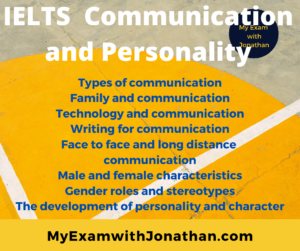
Communication and Personality

I’ve noticed that this topic area can be divided into the following sub-topics.

You can use this to help decide areas of development.

IELTS COMMUNICATION TOPICS

Students on being bullied over their accents.

‘It’s had a lasting impact’: students on being bullied over their accents
Past and present university students talk about their experiences of being made to feel out of place
Happiness: is feeling content more important than purpose and goals?
There are many ways to be happy, but we can also find comfort in the knowledge that our constant dissatisfaction is what makes us human.

Jargon might be infuriating but it also has its uses.

In defence of jargon – it might be infuriating but it also has its uses
Differentiating between bad jargon and good jargon.

Philosophy’s influence on technology design – and why it needs to change.

Philosophy’s influence on technology design – and why it needs to change
How we see the purpose of communication limits our approach to designing technology that makes it possible.

Would we be better off if we sent email into retirement?

Would we be better off if we sent email into retirement?
This year saw the 43rd anniversary of email. Compared to a human working life, email has after more than four decades on the job now reached retirement age. Is it time for email to step aside to allow…

We can use colour to communicate how we feel.

We can use colour to communicate how we feel – here’s how
It has long been known that colour and emotion are linked – so could colour could be used as a language to express how we feel?

Why our screens leave us hungry for more nutritious forms of social interaction.

Why our screens leave us hungry for more nutritious forms of social interaction
Social media is the refined sugar of human communication.

How to talk to your dog.

How to talk to your dog – according to science
New research confirms puppies respond better when we talk to them in a certain way.

Why we must completely rethink how to communicate at work.

Why we must completely rethink how to communicate at work
Do you reply to emails first thing in the morning and last thing at night? Your company should be insisting that you don’t.

Texting is bound to decline but it won’t die out just yet.

Texting is bound to decline but it won’t die out just yet
Reports this week reveal the number of text messages sent between mobile phones has fallen into decline for the first time since the service was introduced. According to figures from Deloitte, the number…

Social media: is it really to blame for young people being lonelier than any other age group?

Social media: is it really to blame for young people being lonelier than any other age group?
Social media can be a great tool to keep in touch with friends – but if you are already lonely, it could make things worse.

If you get on with your boss you’re more likely to lie for them. 

If you get on with your boss you’re more likely to lie for them – new research
Liking your boss and your company can lead to bad behaviour.

How does being bilingual affect your brain? It depends on how you use language.

How does being bilingual affect your brain? It depends on how you use language
Why the benefits of bilingualism aren’t consistent.

What your emojis say about you.

What your emojis say about you
Emoticons reveal subtle clues about your personality – but how do others interpret them?

Why it’s okay for bilingual children to mix languages.

Why it’s okay for bilingual children to mix languages
Being bilingual is not just about learning two languages, it’s about absorbing meaning, negotiating and being flexible when it comes to language.

Prejudices against accents is prevalent.

Accentism is alive and well – and it doesn’t only affect the north of England
Stereotyping people based on their accents is still a big problem at universities in England.

Just how effective are language learning apps?

Just how effective are language learning apps?
Language experts review how one of the world’s most popular language learning apps measures up against traditional teaching.

Finding endless video calls exhausting? 

Finding endless video calls exhausting? You’re not alone
Lots of research shows why video calls are mentally and emotionally taxing.

Overconsumption, not plastic, is the problem.

The war against plastic is distracting us from pollution that cannot be seen
We need to focus on causes like overconsumption, not the material itself.

Stable families, not ‘traditional’ ones, key to children’s education success.

Stable families, not ‘traditional’ ones, key to children’s education success
Growing up in a one parent family doesn’t matter, as long as it’s a stable one.

Happy families? Male acceptance of equality in the home could define the future.

Happy families? Male acceptance of equality in the home could define the future
The idea of family is still undergoing fundamental change, but progress towards an egalitarian era may be hamstrung by class and wealth.

Women in work: how East Germany’s socialist past has influenced West German mothers.

Women in work: how East Germany’s socialist past has influenced West German mothers
East Germany strongly encouraged mothers to participate in the labour market full-time, whereas West Germany propagated a more tradition male breadwinner model.

Study shows equality frees women to follow traditional gender choices – or does it?

Study shows equality frees women to follow traditional gender choices – or does it?
Gender differences in jobs and attitudes are wider in countries with more equality, but that’s not the end of the story.

Four big lessons from the UK’s new gender pay gap reporting rules and what’s next for equality.

Four big lessons from the UK’s new gender pay gap reporting rules and what’s next for equality
The gender pay gap remains stubbornly high in the UK, but the new rules are shaming companies into action.

Big data analysis reveals staggering extent of gender inequality in creative industries.

Big data analysis reveals staggering extent of gender inequality in creative industries
From 2000 to 2013, less than a third of gendered pronouns within articles (for example, ‘he’ and ‘she’) referred to women.

Dear sir/madam — how to write a winning cover letter

Dear sir/madam — how to write a winning cover letter
Seven tips to make you shine.

Writing needs to be taught and practised. Australian schools are dropping the focus too early.

Writing needs to be taught and practised. Australian schools are dropping the focus too early
A survey of NSW teachers shows there is an emphasis on explicitly teaching writing in the early school years. But the amount of time spent teaching writing dips in the middle years.

How universities can help students avoid plagiarism: get them to write better.

How universities can help students avoid plagiarism: get them to write better
More handwritten tasks could force students to avoid the dreaded cut and paste.

Academic writing can be boring – but there are good reasons for that.

Academic writing can be boring – but there are good reasons for that
Academic language wasn’t always rigorous – and it led to people hugging trees to cure their illnesses.

A history of English in five words.

A history of English ... in five words
The extraordinary words that capture the colourful diversity of the English language.

Is Game of Thrones sexist?

Is Game of Thrones sexist?
One reason for the series’ success can undoubtedly be found in its spectacle of violence and sex.

Frozen II: return of the strong female characters that little girls need to see.

Frozen II: return of the strong female characters that little girls need to see
In production as the #metoo uprising took hold, the sequel is a real chance for Disney to normalise strong, independent female characters.

People Like Us by Hashi Mohamed 

BBC Radio 4 - People Like Us by Hashi Mohamed - Available now
Hashi Mohamed reads from his book People Like Us, an exploration of social mobility.
CRIME IELTS READING
IELTS Topic Areas - Crime and Punishment
IELTS Topic Articles that feature in the IELTS test for Vocabulary and Topic Awareness Without topic awareness, you can’t fully answer the question Without vocabulary, the question can’t be fully answered I’ve prepared a selection of good articles to read according to their topic area. I am adding to this list all the time. This […]
EDUCATION IELTS ARTICLES
IELTS Topic Areas - Education
IELTS Reading – Topics and Articles that feature in the IELTS test. ″Without topic awareness, you can’t fully answer the question Without vocabulary, the question can’t be fully answered″ I’ve prepared a selection of good articles to read according to their topic area. I am adding to this list all the time. This is one […]
ENVIRONMENT IELTS ARTICLES
IELTS Topic Areas - The Environment
IELTS Reading – Topic Articles that feature in the IELTS test.  ″Without topic awareness, you can’t fully answer the question Without vocabulary, the question can’t be fully answered″ I’ve prepared a selection of good articles to read according to their topic. I am adding to this list all the time so students can acquire vocabulary […]

Food ‘Coming Soon’

Health ‘Coming Soon’

Language ‘Coming Soon’

Reading ‘Coming Soon’

Advertising and Media ‘Coming Soon’

Art and Design ‘Coming Soon’

Business and Money ‘Coming Soon’

Communication and Personality ‘Coming Soon’

Crime and Punishment ‘Coming Soon’

Economics ‘Coming Soon’

Education ‘Coming Soon’

Family and Children ‘Coming Soon’

Food ‘Coming Soon’

Health ‘Coming Soon’

Language ‘Coming Soon’

Reading ‘Coming Soon’

Share
Pin
Share
Tweet
0 Shares

Share this:

  • Click to share on Twitter (Opens in new window)
  • Click to share on Facebook (Opens in new window)
  • Click to share on Pinterest (Opens in new window)
  • Click to share on WhatsApp (Opens in new window)
  • Click to share on Telegram (Opens in new window)
  • Click to share on Tumblr (Opens in new window)
  • Click to share on LinkedIn (Opens in new window)
  • Click to print (Opens in new window)

Like this:

Like Loading...

Invest time in IELTS Topic Areas – Health

By ielts-jonathan.com on 20 October 2020 0

IELTS Topics Health and Exercise

Ways to improve your answer in the most common IELTS topics

I’ve noticed over the years the student’s often lack topic awareness in both IELTS speaking and writing.

As this limits their ability to display the language which is being assessed, it’s important to have at lease some basic knowledge of the topic areas that frequently occur in the IELTS test.

IELTS Topics Health and Exercise

Having a broad awareness of IELTS topic areas also offers the opportunity to provide answers and essays that surprise the examiner and generate interest, thereby putting your work on a higher footing.

For this reason, I’m collecting  good articles to read according to their topic area; the broad topic areas that come up in areas of the IELTS exam.  I am adding to this list all the time.

This is one of the many articles I’ve listened to or read this week which, from experience, I know feature heavily in the IELTS test.

The rise of the emoji doesn’t spell the end of language
Emojis are mainly used to enhance the meaning of words in texts – they won’t replace them altogether.

Why should I invest time in IELTS reading

Having an awareness of IELTS topic areas indicates in your writing and speaking that your opinions can be relevant. Being prepared means that you are better positioned to give an opinion on any number of popular topic areas. This is especially the case in writing; the ability to generate ideas under the pressure of the exam is usually down to a lack of knowledge around the key topic areas.

Common IELTS Topics

So, I’ve created a page for IELTS worthy reading and listening articles. These will be featured around the most common topic areas I have seen in IELTS reading, writing and listening.

Using some of these resources is not only good for increasing vocabulary levels, reading comprehension and speed, but will help provide a foundation of ideas important for topic awareness and idea generation. 

If you want a list of the main topic areas and the subheadings, you can find out more here  but this is the new link I am creating. 

I recommend you identify areas you’re not familiar with and flick through some of the topics postings below. Choose a few to read or listen and if your vocabulary is a weak spot, note down words and phrases you can reuse in the future. 

Knowledge of medicinal plants at risk as languages die out
Loss of linguistic diversity means less chance to discover age-old remedies not known to science, study warns

Students on being bullied over their accents.

‘It’s had a lasting impact’: students on being bullied over their accents
Past and present university students talk about their experiences of being made to feel out of place

Jargon might be infuriating but it also has its uses.

In defence of jargon – it might be infuriating but it also has its uses
Differentiating between bad jargon and good jargon.

Philosophy’s influence on technology design – and why it needs to change.

Philosophy’s influence on technology design – and why it needs to change
How we see the purpose of communication limits our approach to designing technology that makes it possible.

Would we be better off if we sent email into retirement?

Would we be better off if we sent email into retirement?
This year saw the 43rd anniversary of email. Compared to a human working life, email has after more than four decades on the job now reached retirement age. Is it time for email to step aside to allow…

We can use colour to communicate how we feel.

We can use colour to communicate how we feel – here’s how
It has long been known that colour and emotion are linked – so could colour could be used as a language to express how we feel?
A hot bath has benefits similar to exercise
A hot bath burns calories, helps control blood sugar and keeps your blood vessels healthy. What’s not to like?

Why our screens leave us hungry for more nutritious forms of social interaction.

Why our screens leave us hungry for more nutritious forms of social interaction
Social media is the refined sugar of human communication.
Poor sleep linked to inability to focus – new study
Distraction in poor sleepers could be linked to a different brain process than previously thought.

How to talk to your dog.

How to talk to your dog – according to science
New research confirms puppies respond better when we talk to them in a certain way.

Why we must completely rethink how to communicate at work.

Why we must completely rethink how to communicate at work
Do you reply to emails first thing in the morning and last thing at night? Your company should be insisting that you don’t.
How quickly do we become unfit?
We lose some fitness ‘gains’ in as little as four weeks.

Texting is bound to decline but it won’t die out just yet.

Texting is bound to decline but it won’t die out just yet
Reports this week reveal the number of text messages sent between mobile phones has fallen into decline for the first time since the service was introduced. According to figures from Deloitte, the number…

Social media: is it really to blame for young people being lonelier than any other age group?

Social media: is it really to blame for young people being lonelier than any other age group?
Social media can be a great tool to keep in touch with friends – but if you are already lonely, it could make things worse.

If you get on with your boss you’re more likely to lie for them. 

If you get on with your boss you’re more likely to lie for them – new research
Liking your boss and your company can lead to bad behaviour.

How does being bilingual affect your brain? It depends on how you use language.

How does being bilingual affect your brain? It depends on how you use language
Why the benefits of bilingualism aren’t consistent.

What your emojis say about you.

What your emojis say about you
Emoticons reveal subtle clues about your personality – but how do others interpret them?

Why it’s okay for bilingual children to mix languages.

Why it’s okay for bilingual children to mix languages
Being bilingual is not just about learning two languages, it’s about absorbing meaning, negotiating and being flexible when it comes to language.

Prejudices against accents is prevalent.

Accentism is alive and well – and it doesn’t only affect the north of England
Stereotyping people based on their accents is still a big problem at universities in England.

Just how effective are language learning apps?

Just how effective are language learning apps?
Language experts review how one of the world’s most popular language learning apps measures up against traditional teaching.

Finding endless video calls exhausting? 

Finding endless video calls exhausting? You’re not alone
Lots of research shows why video calls are mentally and emotionally taxing.

Overconsumption, not plastic, is the problem.

The war against plastic is distracting us from pollution that cannot be seen
We need to focus on causes like overconsumption, not the material itself.

Stable families, not ‘traditional’ ones, key to children’s education success.

Stable families, not ‘traditional’ ones, key to children’s education success
Growing up in a one parent family doesn’t matter, as long as it’s a stable one.

Happy families? Male acceptance of equality in the home could define the future.

Happy families? Male acceptance of equality in the home could define the future
The idea of family is still undergoing fundamental change, but progress towards an egalitarian era may be hamstrung by class and wealth.

Women in work: how East Germany’s socialist past has influenced West German mothers.

Women in work: how East Germany’s socialist past has influenced West German mothers
East Germany strongly encouraged mothers to participate in the labour market full-time, whereas West Germany propagated a more tradition male breadwinner model.

Study shows equality frees women to follow traditional gender choices – or does it?

Study shows equality frees women to follow traditional gender choices – or does it?
Gender differences in jobs and attitudes are wider in countries with more equality, but that’s not the end of the story.

Four big lessons from the UK’s new gender pay gap reporting rules and what’s next for equality.

Four big lessons from the UK’s new gender pay gap reporting rules and what’s next for equality
The gender pay gap remains stubbornly high in the UK, but the new rules are shaming companies into action.

Big data analysis reveals staggering extent of gender inequality in creative industries.

Big data analysis reveals staggering extent of gender inequality in creative industries
From 2000 to 2013, less than a third of gendered pronouns within articles (for example, ‘he’ and ‘she’) referred to women.

Dear sir/madam — how to write a winning cover letter

Dear sir/madam — how to write a winning cover letter
Seven tips to make you shine.

Writing needs to be taught and practised. Australian schools are dropping the focus too early.

Writing needs to be taught and practised. Australian schools are dropping the focus too early
A survey of NSW teachers shows there is an emphasis on explicitly teaching writing in the early school years. But the amount of time spent teaching writing dips in the middle years.

How universities can help students avoid plagiarism: get them to write better.

How universities can help students avoid plagiarism: get them to write better
More handwritten tasks could force students to avoid the dreaded cut and paste.

Academic writing can be boring – but there are good reasons for that.

Academic writing can be boring – but there are good reasons for that
Academic language wasn’t always rigorous – and it led to people hugging trees to cure their illnesses.

A history of English in five words.

A history of English ... in five words
The extraordinary words that capture the colourful diversity of the English language.

Is Game of Thrones sexist?

Is Game of Thrones sexist?
One reason for the series’ success can undoubtedly be found in its spectacle of violence and sex.

Frozen II: return of the strong female characters that little girls need to see.

Frozen II: return of the strong female characters that little girls need to see
In production as the #metoo uprising took hold, the sequel is a real chance for Disney to normalise strong, independent female characters.

People Like Us by Hashi Mohamed 

BBC Radio 4 - People Like Us by Hashi Mohamed - Available now
Hashi Mohamed reads from his book People Like Us, an exploration of social mobility.
CRIME IELTS READING
IELTS Topic Areas - Crime and Punishment
IELTS Topic Articles that feature in the IELTS test for Vocabulary and Topic Awareness Without topic awareness, you can’t fully answer the question Without vocabulary, the question can’t be fully answered I’ve prepared a selection of good articles to read according to their topic area. I am adding to this list all the time. This […]
EDUCATION IELTS ARTICLES
IELTS Topic Areas - Education
IELTS Reading – Topics and Articles that feature in the IELTS test. ″Without topic awareness, you can’t fully answer the question Without vocabulary, the question can’t be fully answered″ I’ve prepared a selection of good articles to read according to their topic area. I am adding to this list all the time. This is one […]
ENVIRONMENT IELTS ARTICLES
IELTS Topic Areas - The Environment
IELTS Reading – Topic Articles that feature in the IELTS test.  ″Without topic awareness, you can’t fully answer the question Without vocabulary, the question can’t be fully answered″ I’ve prepared a selection of good articles to read according to their topic. I am adding to this list all the time so students can acquire vocabulary […]

Share
Pin
Share
Tweet
0 Shares

I’m Jonathan

I’ve taught IELTS and University English in more than a dozen universities and schools around the world.

I’m a parent, traveller and passionate about language teaching and helping students achieve their dreams.

Whilst living in Austria or working in Asia, I run IELTS courses to help students get to where they want to be.

If you are serious about IELTS, connect with me to see how I can help you.

Sign up to the Newsletter

Share this:

  • Click to share on Twitter (Opens in new window)
  • Click to share on Facebook (Opens in new window)
  • Click to share on Pinterest (Opens in new window)
  • Click to share on WhatsApp (Opens in new window)
  • Click to share on Telegram (Opens in new window)
  • Click to share on Tumblr (Opens in new window)
  • Click to share on LinkedIn (Opens in new window)
  • Click to print (Opens in new window)

Like this:

Like Loading...
  • « Go to Previous Page
  • Page 1
  • Page 2
  • Page 3
  • Page 4
  • Page 5
  • Go to Next Page »

Primary Sidebar

Navigation

  • All IELTS Guides
  • IELTS General
  • IELTS Listening
  • IELTS Reading
  • IELTS Speaking
  • IELTS Vocabulary Guides
  • IELTS Writing
  • Writing Task 2

IELTS WRITING COURSE

Course Members Access

Train for IELTS with my Courses and Feedback

IELTS COURSE AND MEMBERSHIP WITH JONATHAN

IELTS OVERVIEW

  • Free Online IELTS Training & Practice Materials | IELTS Jonathan
  • General Task 1
  • How can IELTS Reading be challenging and how to overcome this 2023
  • How IELTS Listening can be challenging and how to overcome this
  • How to easily prepare for IELTS Writing Task 2 without the stress
  • How to write IELTS Task 1 – IELTS Essay Collection Explainers
  • IELTS WRITING FEEDBACK PURCHASE
  • Task 1 IELTS
  • Task 2 IELTS
  • The secrets to a great IELTS speaking interview
  • Ways to learn IELTS VOCABULARY?
  • What are the basics for writing an effective IELTS Task 1 report

Recent Posts

  • Exploring the Intelligence of Crows | IELTS Reading Practice 7 – IELTS Jonathan
  • Unraveling the Origins of Writing | IELTS Reading Practice 7 – IELTS Jonathan
  • Exploring the Seaweeds of New Zealand | IELTS Reading Practice 7 – IELTS Jonathan
  • IELTS Reading Practice 7: Sections 1 to 3 – Questions and Answers | IELTS Jonathan

  • IELTS Reading Practice 6: Sections 1 to 3 – Questions and Answers | IELTS Jonathan


  • IELTS Reading Practice 6 – Hypnotism
  • IELTS Reading Practice 6 – Revolutions in Mapping

  • IELTS Reading Practice 6 – Spider silk cuts weight of bridges
  • General Task 1 IELTS Letter of Invitation
  • IELTS Listening Practice Academic Test 7 | Start Improving Your IELTS Test Listening Skills – IELTS Jonathan

Recent Comments

  • Adel Ibrahim on How to open and close a formal letter in IELTS General writing.
  • ielts-jonathan.com on General Task 1 IELTS Letter of Invitation
  • Ankit on General Task 1 IELTS Letter of Invitation
  • Tars on How to write a strong Introduction for IELTS Task 1
  • Krishna on How to describe Changes and Trends in IELTS Writing Task 1

Let me help you get the IELTS Result you need

JUST WRITING FEEDBACK

Speaking Feedback

  • Facebook
  • Twitter
  • Instagram
  • Email

IELTS TRAINING 

IELTS FEEDBACK

YOUR PRIVACY

TERMS AND CONDITIONS

Copyright © 2026 · 2021. All Rights Reserved. IELTS-JONATHAN.COM - The information provided on the site is for information purposes only. IELTS is a registered trademark of the University of Cambridge, The British Council and IDP Education, Australia. The site and its owners are not affiliated , approved or endorsed by the University of Cambridge, ESOL, The British Council, UKVI, IELTS USA or IDP Education. For comprehensive information, please refer to terms, conditions and disclaimer available on this website. IELTS-JONATHANIELTS Jonathan by Jonathan on Genesis Framework · WordPress · Log in


 

Loading Comments...
 

    %d